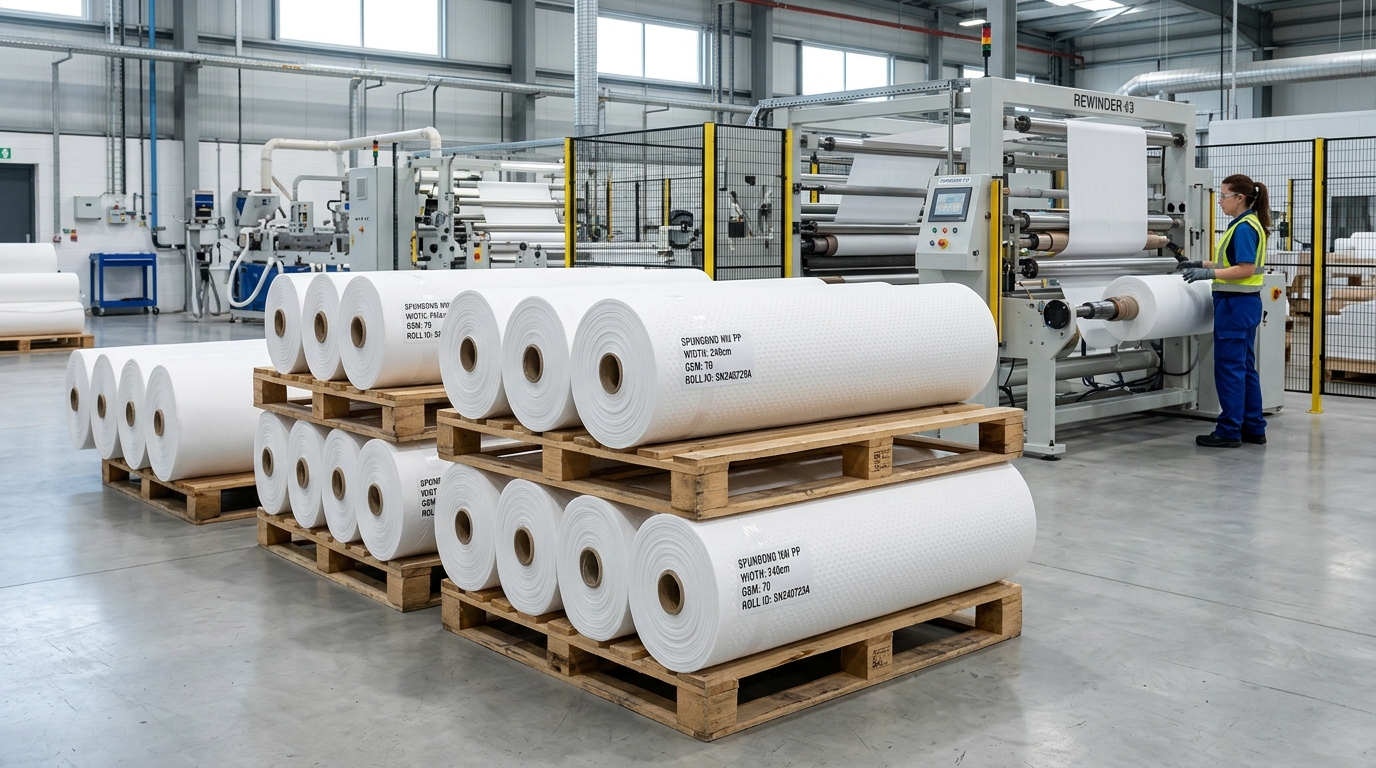
Spunbond Non-woven Fabric Rolls
High-performance Spunbond technical textiles manufactured from virgin polypropylene polymer for industrial converting applications.
What are the key technical characteristics of Thusmaa Spunbond non-woven fabric rolls?
Thusmaa Spunbond non-woven fabrics are engineered from 100% virgin polypropylene homopolymer resins. Continuous filaments are extruded, drawn aerodynamically, and thermally point-bonded using embossed calender rollers (sesame or diamond pattern). Available from 10 to 150 GSM with slit widths up to 3,200 mm, the fabric provides high tensile breaking force, breathability, and uniform web distribution.
Material Performance
Spunbond non-woven fabric combines continuous polypropylene filaments for superior mechanical tensile strength, uniform fiber distribution, and dimensional stability.
1. Spunbond Web Architecture & Bonding
Continuous Filament & Thermal Bonding Structure
Click individual stages to examine how polymer extrusion, web formation, and calender bonding build Spunbond fabric performance.
Continuous Polymer Filaments
15 – 25 Microns (1.5 – 2.5 Denier)Multi-Directional Random Web Formation
Isotropic Web MatrixThermal Point-Bond Calendering
Diamond / Sesame / Oval EmbossEngineered Spunbond Web Synthesis
Spunbond non-woven fabric is synthesized by extruding virgin polypropylene polymer into continuous filaments, aerodynamically orienting them into a multi-directional isotropic web, and thermally fusing them with patterned calender rolls for superior tensile strength, breathability, and converter runnability.
2. Available Specifications & Roll Formats
Spunbond Non-woven Fabric Roll Specifications
Technical manufacturing parameters engineered at Thusmaa Madurai production facility.
| Technical Parameter | Manufacturing Specification / Value |
|---|---|
| Fabric Structure | 100% Polypropylene Spunbond Non-woven (S / SS / SSS Beams) |
| Material Composition | 100% Virgin Polypropylene (PP) Homopolymer |
| Filament Size | 1.5 – 2.5 Denier (15 – 25 Microns) |
| Bonding Pattern | Thermal Point Calender Embossed (Diamond / Sesame / Oval) |
| Basis Weight (GSM) | 10 GSM to 150 GSM (Custom weights available) |
| Standard Roll Width | Up to 3,200 mm (Precision slitting down to 100 mm) |
| Roll Diameter | Up to 1,200 mm (As per converter unwinding specification) |
| Core Diameter | 76 mm (3 inch) / 152 mm (6 inch) heavy-duty paper core |
| Available Colors | Pristine White, Medical Blue, Green, Black, Beige & Custom Tones |
| Surface Finishes | Hydrophilic, Hydrophobic, UV Stabilized, Anti-Static, Soft-Touch |
| Packaging Format | Moisture-barrier polythene stretch film with edge protection caps |
| Quality Verification | MD/CD Tensile Strength, Elongation %, GSM Uniformity, Air Permeability |
3. Suitable Downstream Applications
Healthcare & Medical Apparel
Used by converters to fabricate surgical caps, patient gowns, bedsheets, and procedure covers requiring breathability and tensile strength.
Explore healthcare usePersonal Hygiene Components
Hydrophobic and hydrophilic Spunbond rolls utilized for diaper topsheets, waistband liners, side panels, and hygiene backsheets.
Explore hygiene useIndustrial Protective Apparel
Disposable laboratory coats, cleanroom visitors' wear, protective overalls, and aprons providing dry dust containment and breathability.
Explore protective workwearTechnical Filtration Media
Multi-density air filtration layers for industrial HVAC, automotive cabin air filters, and liquid filter elements.
Explore industrial filtration4. Common Buyer Technical FAQs
What is Spunbond non-woven fabric?
Spunbond non-woven fabric is an engineered synthetic textile manufactured directly from 100% virgin polypropylene (PP) homopolymer. Molten polymer is extruded through precision spinnerets into continuous filaments, aerodynamically drawn and laid onto a vacuum conveyor into a uniform random web, and thermally bonded using heated embossing calender rollers. The continuous filament structure delivers superior tensile strength, tear resistance, breathability, and lint-free durability without chemical binders.
What are the key advantages of Spunbond polypropylene fabric?
Key advantages include: 1) High tensile and tear resistance in both Machine Direction (MD) and Cross Direction (CD); 2) 100% recyclable virgin polypropylene base; 3) Excellent air permeability and breathability; 4) Non-toxic, hypoallergenic, and lint-free surface; 5) Thermal point bonding eliminating chemical adhesives; 6) Dimensional stability during high-speed converter unwinding; and 7) Adaptability to custom topical treatments such as hydrophilic, hydrophobic, UV resistance, and anti-static finishes.
What is the difference between Single Beam (S) and Multi-Beam (SS / SSS) Spunbond fabric?
Single Beam (S) Spunbond uses one spinneret beam to lay down continuous filaments, making it economical for protective covers, packaging, and agriculture. Multi-Beam (SS and SSS) lines deposit two or three consecutive filament streams before the calender roller, resulting in significantly finer fiber distribution, higher opacity, enhanced softness, tighter pore uniformity, and higher tensile strength at lower basis weights.
What basis weight (GSM) ranges and roll widths are available?
Thusmaa manufactures Spunbond non-woven fabric rolls across basis weights from 10 GSM to 150 GSM. Production lines support master roll widths up to 3,200 mm, with in-house precision slitters offering custom widths down to 100 mm with clean, lint-free edge cuts for high-speed automated machinery.
What are the primary applications of Spunbond non-woven fabric?
Spunbond non-woven fabrics are widely used by industrial converters across multiple sectors: medical disposables (surgical caps, patient gowns, shoe covers, bedsheets, mask layers); hygiene products (diaper topsheet, waistband linings, sanitary napkin wraps); packaging & eco-bags (tote shopping bags, garment covers, storage bags); agriculture (crop covers, frost protection sheets, weed barrier); and technical industrial uses (mattress quilting, furniture dust liners, filtration backing).
Request Spunbond Fabric Specifications & Roll Supply Terms
Contact our Madurai manufacturing desk for sample swatches, technical confirmation sheets, and minimum order roll requirements.